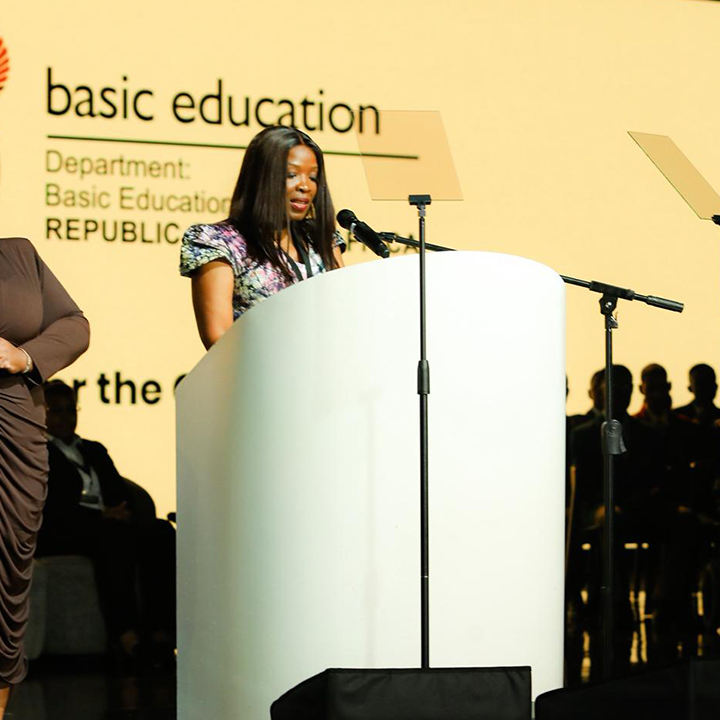
“The importance of impactful initiatives through private and public collaboration that focus on gender equity – to emancipate women from unhealthy and toxic relationships and stop the scourge of gender-based violence cannot be overemphasised,” says Dr Judy Dlamini, Chairperson for the Board of the Gender-Based Violence and Femicide (GBVF) Response Fund. As a champion for the rights of women, Dr Dlamini says, “What drives me is social justice and equity. It is very important as leaders that we take the responsibility of leadership seriously because the challenges we face in our country right now are only made right when leadership delivers on their promise and serves for the greater good.”
“As leaders that we take the responsibility of leadership seriously because the challenges we face in our country right now are only made right when leadership delivers on their promise and serves for the greater good.”
The stark reality is that the most vulnerable in the value chain, aside from children, is women. “As social investors, private purpose has to align with public mission. We deal with human beings and build through human beings. We need to invest in those human beings. We need to apply an intersectional lens to identify the most vulnerable – those who need our help the most – because when we solve for the weakest in the value chain, then the problem is halfway solved,” says Dr Dlamini.

The GBVF Response Fund was launched by President Cyril Ramaphosa, in February 2021, to tackle the scourge of GBVF in South Africa. The Fund aims to play a critical role in making change happen, based on research, awareness and practical support to organisations actively engaged in the fight against this scourge. The Fund believes in funding the change we want to see in society and is committed to taking action against gender-based violence.
“The Fund believes in funding the change we want to see in society and is committed to taking action against gender-based violence.”
“When the Fund was launched, the president stated that GBF is a pandemic, second only to Covid. I say it’s the first. Why? Because it pre-dates Covid. When Covid was forced upon us, the country, the world, ‘weaponised’ their resources to fight the challenge. But when we look at gender-based violence and femicide, we don’t apply the same amount of energy,” says Dr Dlamini.
South Africa is one of the most violent countries in the world, with incidence of femicide reportedly at five times the global average. “Gender-based violence is the scourge of our society,” says Tracey Henry, CEO of Tshikululu Social Investments, and GBVF Response Fund partner. “Many of us either know someone personally or have been the victims of GBV. It is a deeply complex issue. And the work of the GBVF Fund is critical to reach those in marginalised communities and vulnerable women in our society. Sadly, funding for gender-based violence in our country is significantly underrepresented when compared to other sectors, and more is needed to tackle this issue, which we know will not be solved overnight. Collectively we have the power and the platforms to use our voice to ensure that this critical issue is on the agenda of our social investment strategy reviews. As leaders, we also have the power to speak up when we witness any form of sexism, inequality, discrimination, bullying, or prejudice in our workplaces – your voices need to be heard,” she says.
Dr Dlamini says that sometimes inspiration comes from a better understanding of where our focus needs to be, and we need to embrace this in order to instill change. What matters to social investors is having impact. So, when you realise that there is an area that is neglected (such as gender-based violence and femicide), that should serve as inspiration. “If we don’t do something about it, then we all lose. Through private and public collaboration, we can have an impact. Gender-based violence, and femicide is about gender inequality. It’s about the distribution of power that is not equal – where you’ll find an intelligent woman staying in an abusive relationship because she’s thinking about her children. She doesn’t have the resources to raise them. She doesn’t have the resources to leave. So, when we empower women, when we choose to address the issues laid out in the National Strategic Plan on gender-based violence and femicide, only then can we say we have made a difference,” concludes Dr Dlamini.