Much has been made of the frightening number of young South Africans who are unemployed, with both public and private sectors making concerted efforts to address this pressing issue. When you consider that the median age of South Africans veers towards the younger side of 30 (27,6 years), it becomes clear why the success of these efforts has the potential to make or break our economy.
Following the merger of financial services providers Momentum and Metropolitan in 2010, the Momentum Metropolitan Foundation (‘the Foundation’) was born, integrating the various corporate social investment (CSI) initiatives of the group. In 2017 – and given this deepening and dire need – it recalibrated its focus to that of youth employment, with three key portfolios created: Socio-Economic Development (SED), Consumer Financial Education (CFE) and the Staff Volunteer Programme (SVP).
Says Tshego Bokaba, CSI Manager at Momentum Metropolitan, “Our CSI strategy is anchored in enabling youth to become economically active, through establishing strategic partnerships with non-profit organisations (NPOs) that have demonstrated consistent success in job placement.
“As corporate South Africa, we must do everything possible to support young people in realising their ambitions. We need skilled, motivated and trained youth, particularly in and from rural areas, who can meaningfully contribute towards economic growth.”

In terms of the Foundation’s youth employment mandate, there is an emphasis on increasing access to strategic sectors for marginalised groups, with transformation being central to its agenda.
Explains Bokaba, “We’ve prioritised the placement of young people within the information and communications technology (ICT) sector, given its growth potential and ability to pay a living wage. To this end, we’ve partnered with organisations such as WeThinkCode and Life Choices Academy, which empower young people with digital training, and then seek to place them in permanent jobs.”
Another focus is the development of entrepreneurs. “The green economy continues to rise as food security, the environment and health increasingly become a concern, creating new opportunities in agriculture.”
It was this growth potential that led to the Foundation partnering with Agri Enterprises, the commercial arm of Agri SA, to launch its Women in Farming programme earlier this year. This three-year incubator aims to enhance the skills of female farmers, empowering them to better feed their families and create jobs within their communities.
Bokaba says that while a minimum of 50% female participation is targeted in Momentum Metropolitan’s programmes, the Women in Farming programme is 100% women focused. “The programme is designed to provide capacity-building and business skills to black female-owned enterprises in agriculture. This journey helps develop these enterprises into sustainable businesses, through providing platforms that encourage access to market.”
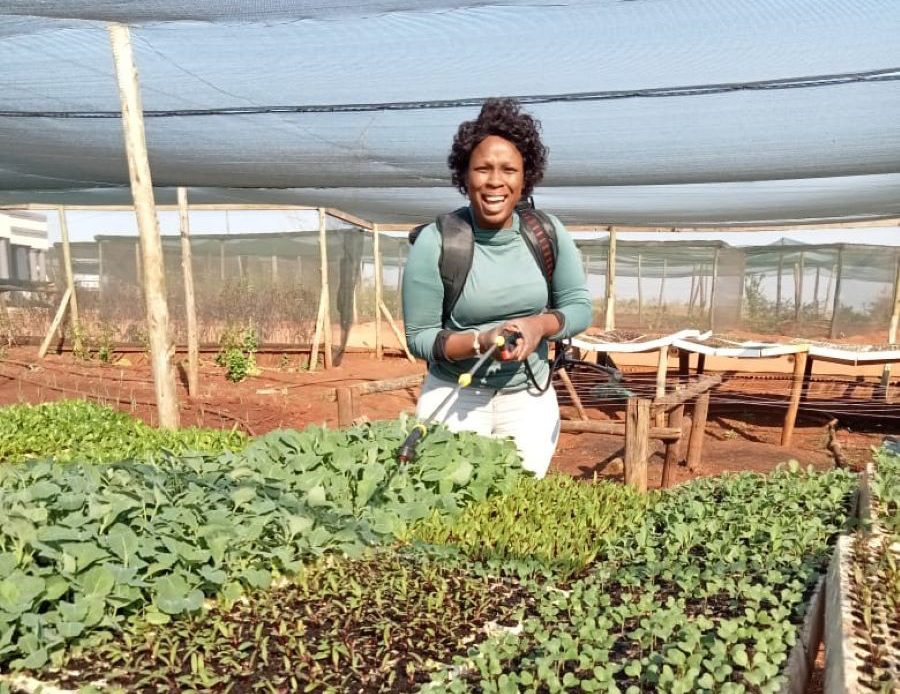
Sixty agricultural entrepreneurs from KwaZulu-Natal are selected to complete the initial training phase, which covered key areas such as mental wellness and analysis; poultry and vegetable farming; agri-business management; agricultural marketing and market access; pests, diseases and weed control; and soil fertility and plant nutrition. “The aim is to equip participants with new knowledge and skills that they can apply within their businesses.”
The farmers are then set to work implementing these skills, while Agri Enterprises performs on-site evaluations and assists with technical support. Once site evaluations are complete, Agri Enterprises and Umgibe Farming Organics and Training Institute determine the business viability of each enterprise. “Some farmers may require further training to reach their full potential while others will proceed to the next phase,” says Bokaba.
Phase two moves from training and education to start-up, where qualifying farmers gain access to working capital, advanced soft skills development and mentorship.
At the end of the incubation programme, the participants become part of the Pietermaritzburg Agri network, qualifying as contracted traders through Umgibe. “Participants are strategically exposed to market access opportunities – something that they identified as being a gap in their business journeys. Increased access allows them to grow their enterprises, which, in turn, will create new employment opportunities in their respective communities, with food security, health and environmental benefits part and parcel.” In addition to the learning journey, two of the female farmers have been invited to Ethiopia for a knowledge transfer session where they will learn more on feed manufacturing.
Says one of the participants, Zamakhanya Makhanya (30), on the value that Momentum Metropolitan’s Women in Farming programme has added to her life: “It’s giving me a better understanding of how to access the market and to ultimately become a successful big-scale female farmer.
“I continue to learn, which makes me a better farmer today than I was yesterday.”